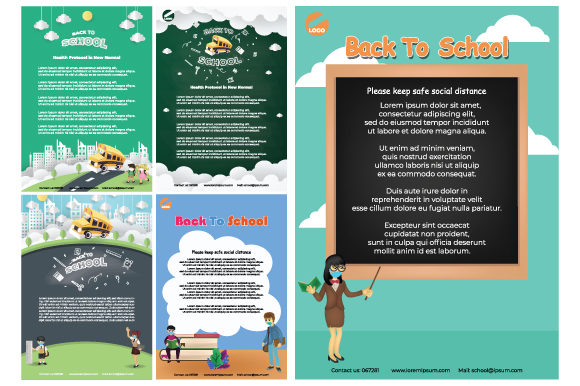
Flyer Education for Back to School 2020: Communicating the New Normal
When we think about back to school 2020, it’s hard not to picture the whirlwind of uncertainty that hit classrooms, kitchens, and admin offices at the same time. Schools were no longer just buildings—they became shifters of schedules, spreaders of safety protocols, and experimenters with hybrid attendance. In the middle of that chaos, one surprisingly reliable tool emerged: the humble flyer. Flyer education for back to school 2020 wasn’t just about handing out pretty paper. It was about getting critical information in front of families, teachers, and students when everything else felt untethered.
I remember walking into my local school district’s webpage in late July 2020. The front page was a mess of PDFs, Zoom links, and contradictory email threads. What actually caught my eye? A single, well-designed flyer taped to the door of the school building. It showed the arrival flow—mask on, temperature check before entering, one-way hallway arrows. The flyer did what the website couldn’t: it gave me, a parent, a quick visual script for how that first drop-off would go. That’s the kind of real-world anchoring flyer education for back to school 2020 offered, especially when everything was new.
Why Flyers Became the Unsung Heroes of School Communication
Let’s be honest: the 2020 back-to-school season was a tsunami of information. Districts published reopening plans that read like legal documents. Parents were expected to digest pages of hybrid rotation schedules, quarantine rules, and mask exceptions. In that flood, flyers acted as lifebuoys. They distilled complex policies into digestible, visual cues. The flyer education for back to school in new normal covid-19 model was perfect because it met people where they were—in hallways, at bus stops, on refrigerator doors, and later, in social media feeds as shareable graphic images.
One practical example: my friend, a middle school principal, spent weeks building a 30-page reopening handbook. On the first day, no one had read it. He switched tactics. He turned the handbook’s core rules into a single flyer education for back to school 2020—six icons, four color codes, and a schedule grid. Attendance shot up in morning briefings because parents and kids could glance and act. That’s the core job a well-crafted flyer does: it translates policy into behavior.
Different Roles, Different Flyer Needs
The beauty of flyer education for back to school 2020 is that it served wildly different people in equally useful ways.
School Administrators and Reopening Teams
If you were on a reopening committee, your job wasn’t just making rules—it was making them stick. Flyers became the quickest way to publicize new attendance windows, cafeteria no-go zones, and the ever-changing mask mandate. A vector EPS file or a JPG template gave you a format you could print at school, upload to the district app, or even project on hallway monitors. The strength? Immediate visual consistency. The limitation? A single flyer couldn’t cover edge cases—like special education class schedules or English language learner versions—so you often needed a series of flyers rather than just one.
Teachers and Classroom Choreographers
Teachers in 2020 were asked to become safety officers, sanitation schedulers, and emotional stabilizers. A teacher I spoke with in August 2020 created her own flyer education for back to school in new normal covid-19 for her third graders. It showed a “clean station” with hand sanitizer, a desk separation diagram, and a simple stoplight system for feelings (“green – good to go”, “yellow – ask for help”, “red – tell a grown-up”). She printed it, laminated it, and posted it on every desk within a week. That flyer saved her from repeating instructions twenty times per day. For teachers, flyers can be both a tool for student understanding and a visual support for kids who struggled to adjust to masked faces.
Parents and Home Initiatives
Parents were the focal point of back-to-school communication. You might have been the one checking emails late at night, trying to pin down whether Thursday was an A-day or a B-day. Flyer education for back to school 2020 came home in backpacks, or sometimes as digital PDFs shared in private parent groups. What worked for us parents wasn’t just the information—it was the format. A flyer on the fridge that listed the week’s meal-pickup schedules, virtual lesson links, and drop-off windows made the morning rush less frantic. The downside? Digital flyers often got lost in email threads, so using both a JPG for mobile sharing and a vector EPS for high-quality print gave families a backup.
Local Businesses and Community Partners
Don’t forget that schools aren’t islands. In 2020, local businesses like pharmacies, groceries, and even laundromats became touchpoints for back-to-school messaging. A community health clinic near me used a flyer to list free mask distribution times alongside school vaccination deadlines. They designed it using a template from a flyer education for back to school 2020 collection, edited the text, and posted it at bus shelters. For businesses, flyers bridge the gap between school communications and public health awareness, especially when you’re targeting families who might not have reliable internet access.
Strengths That Kept Flyers Relevant in a Digital Year
You might think 2020 was the year of the website and the endless Zoom invite. And yes, digital exploded. But flyers had three big advantages that made them essential even during lockdowns.
- Low barrier to creation and distribution. You didn’t need a developer or an IT team. A teacher, a parent volunteer, or a principal could open a vector EPS, adjust the color palette, add local info, and have a printed stack within an hour. During sudden school closures, that speed mattered.
- High trust factor. A flyer isn’t a polished brand ad; it feels like a neighborly note. When parents saw a flyer from the school with COVID guidelines, it often felt more credible than a random district email they ignored.
- Offline accessibility. Not every family had a constant internet connection, especially during remote learning. A printed flyer tucked into a meal distribution bag reached families regardless of connectivity.
Limitations to Keep in Mind
Of course, flyer education for back to school 2020 wasn’t a magic wand. One major limitation: language and literacy. If the flyer was only in English, non-native speaking parents missed vital instructions. Similarly, flyers can be static. They don’t adapt to changes overnight—so you often needed a versioning strategy. If your district shifted from full remote to hybrid mid-September, that first flyer became obsolete quickly.
Another practical limitation is over-saturation. I’ve seen schools that flooded backpacks with a dozen flyers—for lunch forms, mental health services, PE schedules, bus routes, COVID tests. At that point, parents tune out. The key is to pick the high-impact, behavior-changing messages and design each flyer for a single clear action (e.g., “wear your mask this morning”, “submit your attendance preference by Friday”).
Creative Ways Different Schools Used Flyer Education for Back to School in New Normal
I’ve noticed that the schools that got the most traction didn’t treat flyers as afterthoughts. They embedded them into their daily operations. For example:
- Morning entry stations: A large-format poster version of the flyer placed at the school entrance with a floor marking for spacing.
- Laminated desk cards: Mini-flyers for individual desks with reminders about hand-washing routines and “how to ask for help without shouting.”
- Home instruction sets: A single-page foldable flyer that contained on one side the parent’s schedule, and on the other side the child’s online class login info. That was pure gold for busy homes.
- Shared digital versions: Using the JPG as a story graphic on Instagram or Facebook groups, so parents could screenshot it and save it to their phones.
What to Look For When Choosing or Creating a Flyer Template
If you’re planning to create your own flyer education for back to school 2020 material—whether for a school, a daycare, a community center, or your own family—here are a few considerations based on what I’ve seen work and not work.
Hierarchy of information. The title should be a single, urgent phrase (“Return to School Plan: Do This Every Morning”), not a paragraph. Second-level details like dates and times should be in a clear, readable font. Avoid putting critical info in the corners or in small grey italics that parents will miss.
Color psychology. In 2020, soft blues and greens signified safety and calm. Avoid red-heavy designs because they can trigger anxiety, especially for young kids. For COVID-specific flyers, I’ve found that simple icons (a mask icon, a soap droplet, a thermometer) work better than text-heavy explanations.
Print vs. digital. If you’re using a JPG, test it on mobile screens. Squint at it. Does the text still read without zooming? If it’s for print, a vector EPS is your friend—it scales cleanly for posters, handouts, or even stickers. Ask yourself: where will this flyer end up? if it’s on a bus window, it needs giant type. If it’s going into a parent’s email, the file size needs to be small enough not to bounce.
Adaptability. The best templates are those you can remix quickly. That’s why many people look for a vector EPS plus a JPG; the EPS can be edited in vector software for different languages or different weeks. Look for a design that has a simple grid, so you can swap out text without breaking the layout.
Real Talk: Does a Flyer Replace a Strategy?
No. Flyer education for back to school 2020 and flyer education for back to school in new normal covid-19 are communication tactics, not strategies. They work beautifully when paired with video tutorials, in-person explanation, or digital follow-ups. A teacher once told me, “The flyer gets them in the door, but the conversation keeps them there.” That’s stuck with me. Use flyers as triggers for action, not as the whole lesson plan.
I’ve also seen flyers become powerful artifacts of emotional memory. A parent told me she still kept her child’s first back-to-school 2020 flyer. It had the first-grade teacher’s photo, mask rules, and a reassuring note. That flyer did something more than inform. It signaled, “We are in this together, and here’s how we’ll get through it.” In the new normal, that sense of connection was worth more than any agenda item.
If you’re pulling together resources for the upcoming school year—or trying to document the lessons of 2020—don’t overlook the humble flyer. It’s versatile, quick, and human. Whether you start from a ready-made vector EPS template or you design a JPG from scratch, you’re building a bridge between information and action. And that’s exactly what we all needed back then, and might need again.